



Whoa!
I still remember the first time I chased a stuck Solana transaction.
It felt chaotic and a little scary, honestly.
Initially I thought an explorer was just a ledger, but then I realized it’s the interface between human intuition and raw chain data, a translator that can make or break your troubleshooting flow.
This is where Solscan shines and sometimes stumbles.
Seriously?
Search for a wallet and you get a story: balances, token mints, recent transactions.
You can drill down to the exact signature and pore over program logs.
For power users that granular visibility is invaluable, though actually, wait—let me rephrase that: it’s invaluable when you know what to look for and how to read it, which is a different skill than just clicking around.
The learning curve bites less with Solscan than some alternatives.
Wow!
The token pages are neat and practical.
They show holders, transfers, and mint authority history.
If you care about liquidity or ownership concentration, those charts and holder lists give you immediate intuition (and sometimes alarm).
I use that feature all the time when sizing up a token.
Hmm…
Program interaction tracing is a nicer-than-expected feature.
You get instruction decoding for a growing set of programs, which helps when a swap or stake goes sideways.
On the other hand, not every program is perfectly decoded; somethin’ will show up as raw data and you have to infer intent from logs, which is annoying.
Still, it’s often faster than digging through RPC returns alone.
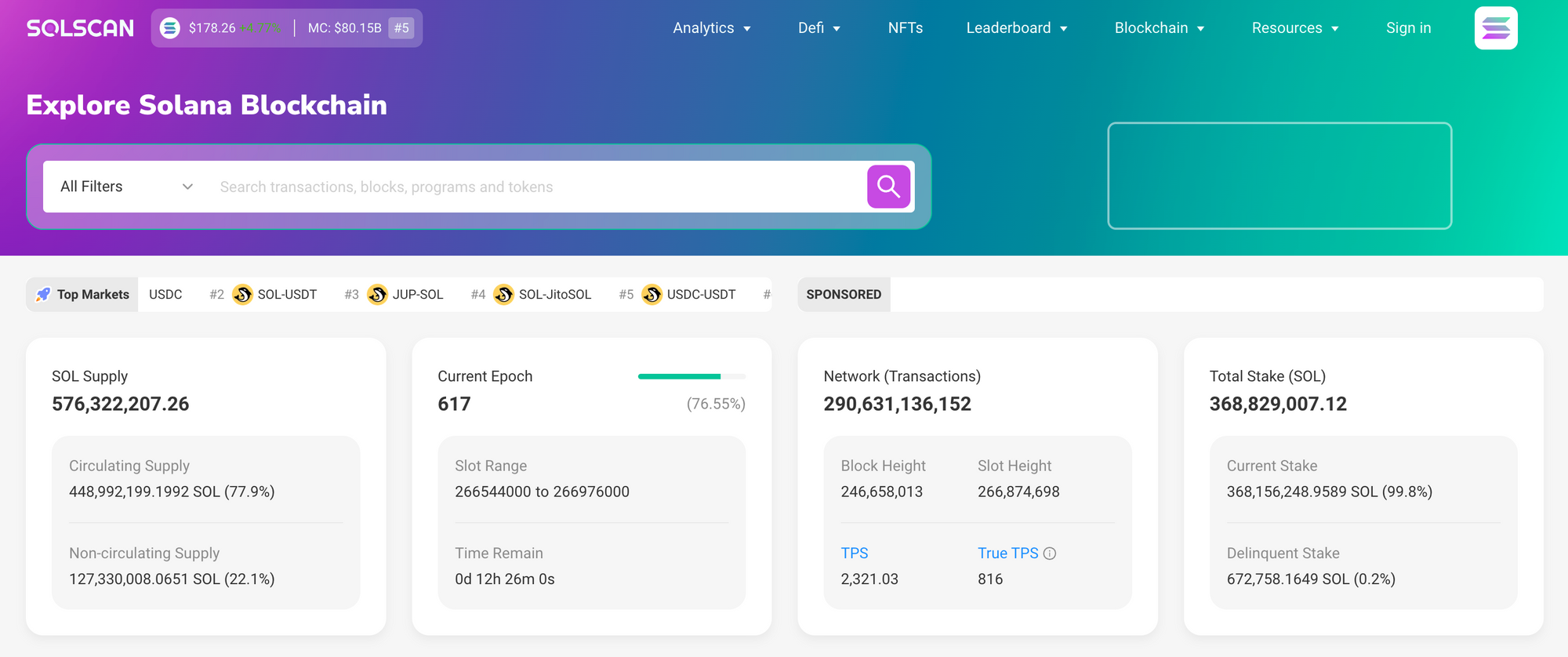
How I Actually Use solscan in real workflows
Here’s the thing.
When I’m helping a friend recover from a failed swap, I paste the signature into the search bar and start with the runtime logs.
That tells me whether the program returned a known error, ran out of compute, or emitted an unexpected event.
I’m biased, but that step cuts debugging time by half for common issues—mostly because Solscan surfaces the logs with a friendly UI instead of leaving you to parse raw RPC blobs.
(oh, and by the way… the address bookmarklet I use is dumb simple.)
Okay, quick aside.
Solscan also exposes analytics like TPS charts, average block times, and fee trends.
Those dashboards give you macro context when a recent outage or congestion scare happens.
On one hand, they’re not as deep as a full-on analytics platform; though actually they’re excellent for quick situational awareness and for confirming whether an issue is network-wide or local to one program.
My instinct said “this is basic,” but data proved it’s usually enough.
Really?
There’s an API too, and it’s handy for automations.
You can pull token holder lists or transaction details and feed them into simple scripts that monitor balances or watch for big transfers.
I built a small notifier that pings me when whale moves cross thresholds—very very useful during volatile NFT drops.
That approach isn’t enterprise-grade, but for developer and community tooling it’s solid.
Whoa!
Privacy and trust matter here.
Solscan is a third‑party viewer; it queries public RPC nodes and indexes data, so you should assume indexing delays and occasional discrepancies compared to your RPC source.
Initially I thought explorers were always canonical, but actually they’re derived views—so when accuracy is critical, cross-check raw RPC or on‑chain data.
That distinction saved me from making a bad call once.
Hmm…
What bugs me about explorers in general is feature fragmentation.
Some tools focus on NFTs, some on tokens, some on developer traces, and few tie everything together smoothly.
Solscan does a decent job stitching those areas, though it isn’t perfect (search relevancy can be finicky, and UI updates sometimes shift menus unexpectedly).
Still, the practical trade-offs make it my default when I’m in a hurry.
Alright, practical tips.
If you want to troubleshoot a transaction: copy the signature, open Solscan, and inspect the inner instructions and program logs first.
Then check the token mint page for holder concentration and recent big transfers.
If you’re monitoring network health, glance at TPS, block time, and fee trend lines to see if a spike explains slow confirmations.
Follow those steps and you’ll avoid a lot of guesswork.
FAQ — Quick answers
Is Solscan safe to use?
Yes for read-only inspection.
It surfaces public on‑chain data and is widely used by the Solana community, but never paste private keys or seed phrases into any explorer.
For sensitive verifications, cross-check with another explorer or raw RPC.
How does Solscan compare to other explorers?
It balances usability and depth well.
Some alternatives specialize (deeper analytics, different UX), though if you want a fast, practical tool for daily Solana work, solscan is a solid pick.
I’m not 100% sure it’s the perfect fit for everyone, but it’s my go-to.
